







Organizations today face a paradox.
Businesses are investing heavily in technology, innovation, client experience initiatives, and new products. Yet despite these investments, many organizations continue to struggle with client loyalty, retention, and long-term relationship growth.
The reason is simple.
Clients no longer see meaningful differences between competitors.
Products can be copied. Services can be replicated. Even pricing advantages can disappear quickly.
With easy access to market information, today’s clients have become more proactive – independently exploring alternatives, evaluating solutions, and making informed decisions that best fit their needs.
This creates an important challenge for sales:
The Differentiation Challenge
As products, services, and even client experiences become increasingly similar, organizations face a fundamental question:
How can they create meaningful differentiation when competitors can often match what they offer?
For decades, sales professionals and organizations have focused on improving operational efficiency, expanding offerings, and enhancing client experiences.
While these initiatives remain important, they are no longer enough on their own.
Today, every interaction contributes to how clients perceive an organization. Every conversation, service experience, digital interaction, and commitment either strengthens or weakens this fragile relationship.
As client expectations continue to rise, sales teams can no longer rely solely on what stand out in the competition.
Over the past few decades, the way clients evaluate solutions has changed significantly. Today, it goes beyond the offerings- clients want to know how well it aligns with their business vision and how meaningfully it contributes to their success.
This is where trust becomes critical.
Trust Is the Foundation of Client Loyalty
Loyalty is the outcome of trust that has been built consistently across client interactions.
Clients are constantly evaluating whether an organization understands them, values them, and can reliably help them achieve their goals.
Every interaction influences this evaluation.
Trust is established through the experiences clients have with the people who represent the organization.
Organizations that consistently strengthen trust create deeper relationships, stronger retention, greater advocacy, and increased willingness from clients to expand their business relationships over time.
Understanding the Trust Equation
Wilson Learning’s core frameworks for building client relationships – Counselor SalespersonTM , highlights the importance and the strategy to build trust.
This model identifies trust is a product of credibility and empathy.
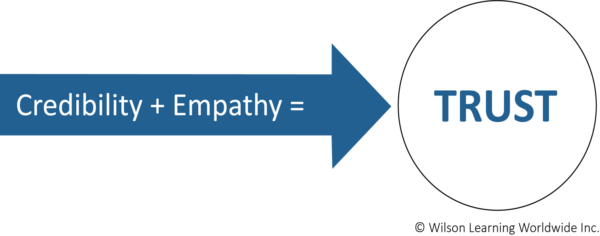
Trust = Credibility + Empathy
Credibility comes from your “back-wheel” strengths, your expertise, technical knowledge, and depth of experience. It’s reflected in how well you understand the business, apply frameworks, and bring informed perspectives to decisions.
However, credibility alone rarely creates lasting loyalty. Clients also want to feel understood.
They want interactions that acknowledge their goals, concerns, challenges, and priorities. This emotional component of the relationship is where empathy becomes essential.
When credibility and empathy work together, trust flourishes.
Trust grows when clients feel understood.
Where Trust Is Really Built
Trust is not built in boardrooms or through brochures. It is built in conversations. It shows up when a sales professional acknowledges a client’s concern before moving to solutions. When a leader is transparent about what they don’t yet know, rather than overextending certainty. And in every interaction where the client feels their success is genuinely valued, not just as a metric, but as a meaningful business outcome.
This is where trust stop being abstract values and become practical tools. Sales professionals who consistently show up with both bring expertise and genuine understanding to every client conversation and become a “trusted advisor”.
Turning Trust into Business Results
Being trusted advisor with your clients helps you to stand out among the hoard of competitor among market.
In markets where products, services, and even client experiences are increasingly similar, trust becomes one of the few competitive advantages that cannot be easily replicated.
The challenge is that trust does not develop by accident. It requires the professionals to consistently demonstrate the behaviours that strengthen relationships, create confidence, and reinforce the organization’s brand experience across every touchpoint.
Sales professionals often aim to create meaningful interactions making them the trusted advisor to their client. Trust has become a strategic advantage that drives long-term business performance.
FAQs
1. Why has client trust become a competitive advantage for organizations?
As products, services, and pricing become increasingly similar, trust is one of the few differentiators competitors cannot easily replicate. Organizations that earn trust build stronger client loyalty, retention, and long-term business growth.
2. Why is it becoming harder for organizations to differentiate themselves?
Today’s clients have access to more information and can easily compare alternatives. Since competitors can quickly match products, services, and experiences, organizations must differentiate through the quality of their client relationships.
3. What is the relationship between trust and client loyalty?
Client loyalty is built on consistent trust. When clients believe an organization understands their needs, delivers on commitments, and supports their success, they are more likely to remain loyal and expand the relationship.
4. What is the Trust Equation in Wilson Learning’s Counselor Salesperson™ model?
The Trust Equation states that Trust = Credibility + Empathy. Credibility comes from expertise and business knowledge, while empathy reflects a genuine understanding of the client’s goals and challenges.
5. How can sales professionals build trust with clients?
Trust is built through consistent, meaningful interactions. Demonstrating expertise, listening actively, understanding client priorities, and communicating honestly help sales professionals become trusted advisors.
6 . How does trust contribute to better business results?
Trust strengthens client relationships, increases retention and advocacy, and creates more opportunities for long-term growth. In highly competitive markets, trusted advisors are more likely to influence buying decisions and deepen client partnerships.
